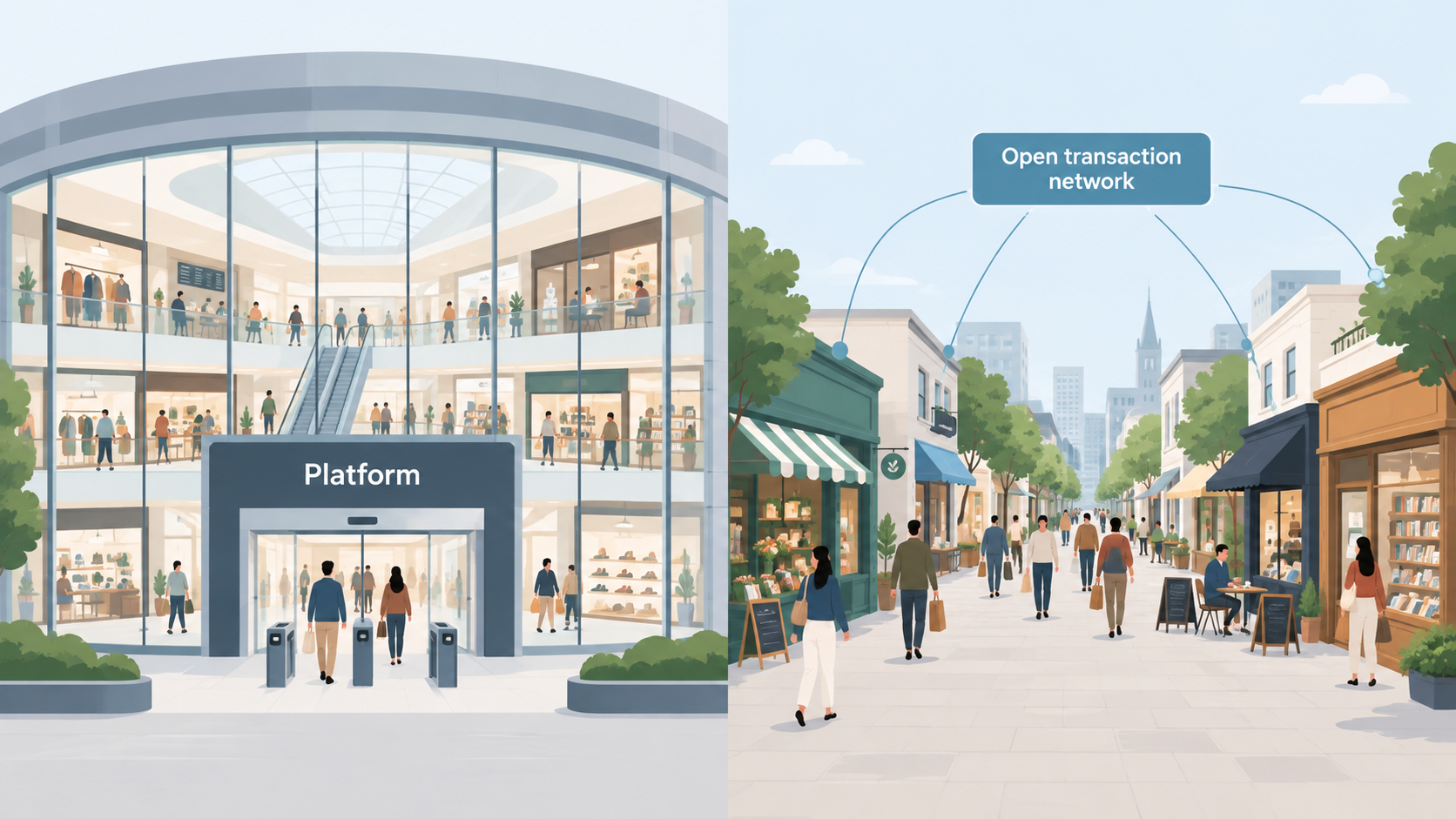
Most digital platforms compete by controlling access. If you want to reach Amazon’s customers, you go through Amazon. If you want to get riders through Uber, you go through Uber. That is the familiar logic of closed platform markets: each intermediary controls its own gates, its own users, and the transactions that pass through them. It is no accident that the European Union chose the term “gatekeeper” in the Digital Markets Act: in many digital markets, platforms are not just intermediaries, but the very gateways through which firms must pass to reach users.
Open Transaction Networks, or OTNs, point to a different architecture. Instead of one platform owning the whole marketplace, a shared protocol allows buyers and sellers connected through different apps to discover one another and transact. In that world, apps still compete, but they compete on top of common transactional rails rather than through exclusive control of access.
What is an OTN, in plain English?
A simple way to think about an OTN is to compare a shopping mall with a city centre. A conventional digital platform is like a privately owned shopping mall. The mall operator controls the entrances, decides which shops can operate inside, organises visibility and transactions, and has a direct relationship with visitors. Merchants wanting access to the mall’s customers must accept the operator’s conditions. An OTN is closer to a city centre. The centre provides common infrastructure—streets, signage, public space, perhaps shared payment or delivery arrangements—but it does not control which shops open or which consumers enter. The businesses still compete fiercely: on products, prices, service, location, and customer experience. Yet the basic infrastructure that makes exchange possible is shared rather than privately controlled.
The analogy is not exact, of course. In an OTN, the “streets” are digital rules for discovery, matching, order routing, and payment, not physical pavements. But the central idea is the same: the infrastructure is open to compliant participants, while competition takes place among the services built on top of it. OTNs therefore separate two layers that proprietary platforms usually bundle together: a common transaction layer and a competitive access layer. Apps can still compete through interface design, search, logistics, payments, credit, customer support, and other complementary services. OTNs do not eliminate platforms; they limit their ability to own the entire marketplace.
India’s Open Network for Digital Commerce, or ONDC, is the leading real-world illustration of this idea. The same logic also appears in Namma Yatri for urban mobility, and more broadly in open banking, digital identity systems, and interoperable payment networks. What ties these initiatives together is the idea that common standards can widen access while preserving competition among service providers.
Why GDN became interested
This is precisely why the Global Development Network (GDN) has taken an interest in OTNs. GDN is an international organisation that supports research on development challenges, and its OTN programme sits within a broader concern with digitalisation, inclusion, and institutional design.
From a development perspective, OTNs are attractive because they may lower barriers to entry, broaden market access for smaller firms, and reduce dependence on a handful of vertically integrated intermediaries. But these are possibilities, not guarantees. Whether OTNs actually deliver on those promises depends on incentives: will private intermediaries want to join such a network, who will capture the gains, and under what conditions will openness be sustainable?
That is where economics can contribute something useful. The policy conversation around digital public infrastructure often moves quickly from aspiration to prescription. OTNs invite a more careful question: what happens to competition, pricing, and welfare when proprietary platforms no longer fully control access to transactions?
The project behind the paper
GDN contacted me to help think through these issues more formally and to develop a theoretical model of OTNs’ impacts. I worked on this project with my post-doc Sumit Shrivastav, alongside Kishen Shastry, Daniele Rinaldo, and Jean-Louis Arcand, the co-authors of the working paper Open Transaction Networks and Platform Competition.
The paper asks a deceptively simple question: suppose two competing two-sided platforms can decide whether to comply with a shared transaction protocol on the buyer side, the seller side, both sides, or neither. What kind of market structure emerges, and who gains from it?
That question sits at the intersection of platform economics, interoperability, and digital public infrastructure. It speaks directly to a broader theme that often comes back in this blog: platform strategy is not just about how firms create value, but also about how they organise access to that value—and how market design affects who gets to keep it.
The main result: openness can emerge on its own
The standard view in the economics of interoperability is that firms tend to underinvest in it. The intuition is straightforward: if users of one network can interact with users of another, then exclusivity weakens, and some of the rents created by network effects are lost. That argument has often been used to justify interoperability mandates in digital markets.
Our model shows that OTNs can overturn that logic. In the model, full compliance is a dominant strategy for each platform, and the fully open configuration emerges as the unique equilibrium. In other words, platforms may choose full openness even without being forced to (as long as the compliance costs are sufficiently low).
Why? Because compliance does two things at once. First, it expands the trading opportunities available to a platform’s users by connecting them to previously unattached participants beyond the two proprietary platforms. Second, when platforms comply on opposite sides, they become interoperable, which softens competition for exclusive control over users.
This is the paper’s central twist: OTNs can make interoperability privately profitable rather than privately unattractive. Openness is no longer just a social ideal that firms resist; under some conditions, it becomes a strategy firms actively prefer.
But openness does not automatically favour users
This is where the story becomes more interesting. Full compliance enlarges the market, but it also changes the way platforms price access. In a standard two-sided market, platforms often subsidise one side because attracting that side creates value on the other side. Those cross-side subsidies are part of what competition looks like when platforms fight for exclusive access to users.
Full interoperability weakens the need for such subsidies. Once a buyer on one platform can reach sellers on another, the competitive value of “owning” that buyer falls. As a result, platforms can withdraw part of the subsidy they used to offer and raise access fees. In the model, much of the profit gain from openness is therefore not newly created value, but a transfer: platforms recapture a subsidy they had previously ceded to users.
This leads to a sharp welfare result. In the costless model, full compliance maximises total welfare, but a planner who cares only about users will often prefer compliance on a single side. Same-side compliance expands reach without raising fees, whereas full interoperability expands reach but also softens price competition and can leave users worse off than a more limited form of openness.
That is the deeper contribution of the paper, at least in my view. OTNs should not be understood only as interoperability devices. They should also be understood as mechanisms that redistribute network-generated rents. They shift value away from incumbent users who benefited from closed-platform competition, and toward platforms and previously excluded participants.
Inclusion, but at whose expense?
This is why OTNs matter so much for digital public infrastructure. The unattached buyers and sellers in the model can be interpreted as those left at the margins of proprietary ecosystems: small merchants, remote users, informal businesses, or people whose circumstances make standard platform participation unattractive or impossible.
Opening the network gives these groups access to trading opportunities that were previously out of reach. In that sense, OTNs can indeed be instruments of inclusion. But that inclusion is not costless. In the model, incumbent users finance it partly by losing the subsidies they previously enjoyed, and partly through the new balance of bargaining power between platforms and users.
This is what makes the policy debate more subtle than a simple opposition between “closed=bad” and “open=good.” Open architectures can improve access and total welfare while still redistributing surplus in ways that are not obviously favourable to attached users. If policymakers care especially about those users, then openness may need to be combined with some form of price discipline or governance constraint.
The practical message is that architecture and pricing are interdependent. Opening the network without paying attention to how platforms charge for access may improve efficiency while falling short on user welfare. That is one reason examples such as Namma Yatri are interesting: they combine open architecture with a pricing model designed to limit rent extraction.
The sequel: from theory to data
A natural sequel to this work is empirical. The next step is to confront the model with evidence from live OTN deployments—most obviously ONDC, and perhaps also Namma Yatri—to see whether its main predictions survive contact with real markets. The paper already sketches this research agenda in some detail, identifying the kinds of data one would need: transaction-level records linking buyer apps and seller apps, fee schedules, participation data, rollout dates for buyer-side and seller-side compliance, and ideally richer information on onboarding, multi-homing, and the effective size of previously unattached user pools.
That empirical programme is attractive because the theory generates unusually sharp predictions. It suggests, for example, that same-side compliance should leave effective fees broadly unchanged, while full compliance should raise them; that the degree of interoperability should matter linearly for fee changes; and that some of the model’s assumptions—such as single-homing or exogenous unattached pools—can themselves be tested rather than simply imposed. More broadly, the paper offers a framework for measuring how OTNs affect pricing, participation, and the distribution of surplus, which is ultimately where the policy debate has to be settled.
A final platform-strategy lesson
For readers of Platform Strategies, the broader lesson is clear enough. Platform strategy is often described as the art of building and defending a moat. OTNs remind us that another strategic option exists: not owning the moat, but competing to be the best gateway into a shared infrastructure.
That does not make the old questions disappear. It simply relocates them. Instead of asking only who owns the network, we also have to ask who sets the rules of access, who captures the rents generated by connectivity, and how openness changes the balance between efficiency, inclusion, and market power. OTNs are interesting not because they make platforms irrelevant, but because they force us to think much more carefully about what platforms should—and should not—be allowed to control.