
In my previous post, I used Airbnb’s checkout-chores dispute to explore a central question of platform strategy: whom should a platform favour when its user groups’ interests conflict?
But before deciding how to resolve a conflict, a platform must recognise it. A promise that sounds compelling to guests—“Enjoy your stay without worrying about cleaning”—creates obligations for someone else. Equally, a promise that appeals to hosts—“Earn rental income with minimal effort”—depends partly on how guests behave.
For entrepreneurs designing a platform, the challenge is to spot these connections before they become a source of frustration. This is where the Multisided Value Proposition Canvas, developed with Nicolas Neysen in Platform Strategies, comes in. It builds on a familiar tool but shifts attention from separate customer relationships to the interactions between user groups.
1. Start with jobs, pains, and gains
The Value Proposition Canvas, developed by Alexander Osterwalder and his colleagues, helps businesses connect what they offer with what customers actually need. It brings together two elements: a customer profile and a value map.
The customer profile describes three things:
- Jobs are what customers are trying to accomplish: tasks to complete, problems to solve, or needs to satisfy. They can be functional, social, or emotional. Finding somewhere to sleep is a functional job; feeling relaxed during a holiday is an emotional one.
- Pains are the obstacles, costs, frustrations, and risks associated with getting those jobs done. They can arise before, during, or after the activity.
- Gains are the outcomes and benefits customers seek or would welcome, from basic expectations to pleasant surprises. They are not simply the absence of problems: a memorable experience offers something beyond an uneventful stay.
The value map then describes the products and services offered, their pain relievers, and their gain creators. The objective is to establish a fit: does the offering address the customer’s important jobs, alleviate significant pains, and deliver valued gains? Crucially, this fit is a hypothesis to test with customers, not something established merely by completing the canvas.
Applied to our accommodation example, a guest’s job is not “use Airbnb.” It is to arrange a suitable stay. Searching through listings, booking, and checking in are steps towards that goal—not the goal itself. Likewise, washing dishes is not necessarily a job that guests want help performing. It may instead be a pain attached to the job they actually care about: enjoying their trip.
So far, we have looked at the stay from the guest’s perspective. But someone must provide the accommodation—and deal with what guests leave behind. How should we bring that other perspective into the picture?
2. Why two canvases are not enough
A natural starting point is to prepare two canvases: one for guests and one for hosts. The table below sketches their respective jobs, pains, and gains. These are illustrative hypotheses, not findings about all Airbnb users: different travellers and hosts will attach different priorities to them.
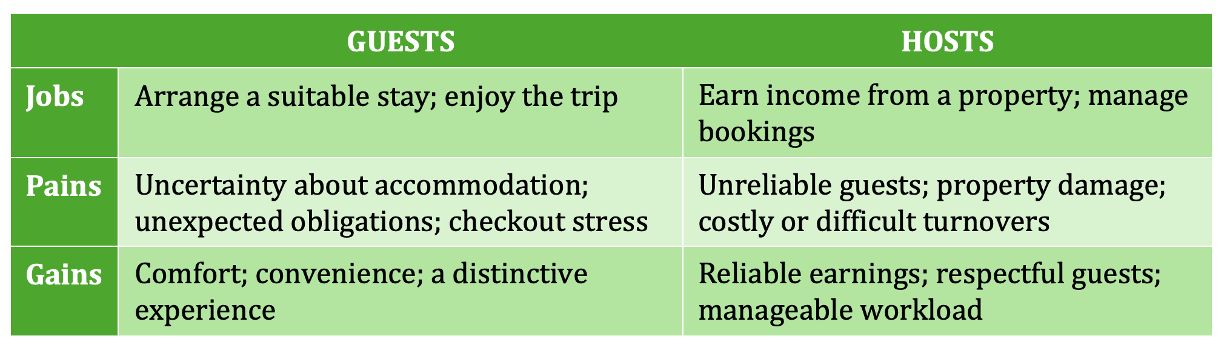
The problem arises if we treat the two canvases as independent. We might design an attractive promise for each group without checking whether the promises can coexist.
An accommodation platform does not itself supply every element of the guest experience. Hosts provide the property and much of the hospitality. Nor does it independently deliver everything hosts value: rental income and a smooth hosting experience depend on guests booking, paying, and behaving responsibly. As Nicolas Neysen and I emphasise in Platform Strategies, platforms facilitate interactions between participants rather than directly controlling every aspect of the service. Their users are therefore not just recipients of value: they also help create it for one another.
The missing element in two disconnected canvases is interdependence. For each proposed pain reliever or gain creator, we need to ask: Who must do what to make this promise possible—and how does that affect their own experience? This is the shift captured by the Multisided Value Proposition Canvas: from examining what a platform offers each group separately to examining how those propositions depend on one another.
3. Connect the promises—and check for conflicts
How do we put this connected perspective to work? Start by identifying the pains each group wants relieved and the gains it hopes to obtain. Then trace how satisfying those needs depends on the other group—and check where the proposed responses reinforce one another or collide.
Let us apply this reasoning to checkout chores. For guests, the relevant pain might be the time, effort, and uncertainty associated with checkout obligations. The desired gain is a convenient departure that lets them enjoy the end of their trip. For hosts, the relevant pain might be the cost and difficulty of preparing the property for the next arrival. The desired gain is a predictable, manageable turnover.
Framing the problem this way matters. “Guests want no chores” and “hosts want guests to clean” describe conflicting solutions. “Guests want convenience” and “hosts want manageable turnovers” describe underlying needs—and leave more room to find alternatives. Once we separate needs from preferred solutions, the question becomes more productive: can we make departures convenient for guests without making turnovers unmanageable for hosts?
4. Evaluate interventions and their cross-side effects
Recognising a conflict does not mean accepting the first trade-off presented. The important distinction is between removing a pain and transferring it. If guests no longer wash the dishes, the dishes still need washing. A guest-facing pain reliever may therefore create a host-facing pain. Conversely, requiring guests to start the laundry may make turnovers easier while making departures less convenient.
The next step is to compare possible interventions, asking not only which pain each one relieves, but also what it requires from the other side. Some measures may reduce the underlying burden; others mainly redistribute it. The table below illustrates the questions a platform should ask.
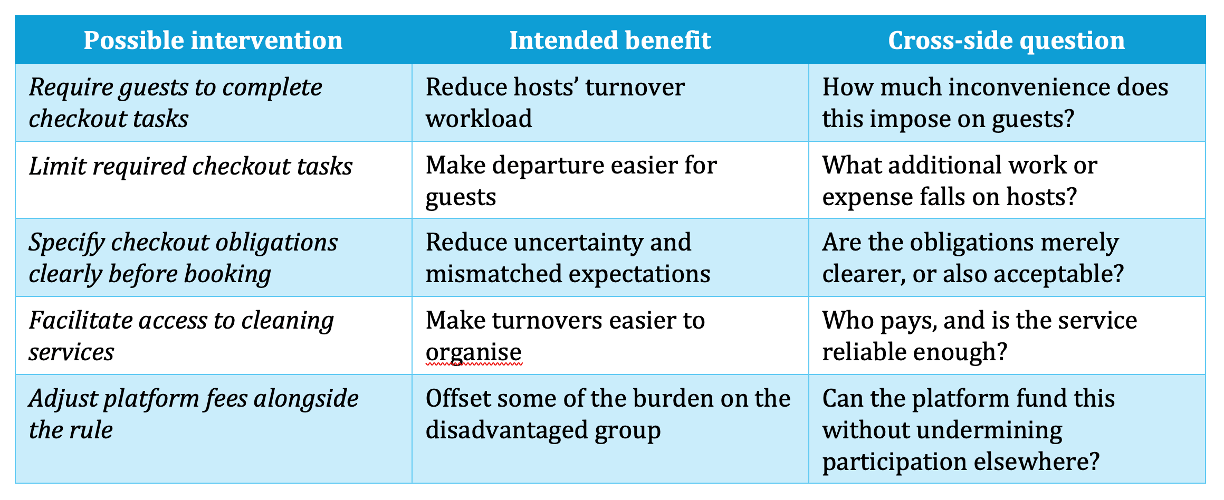
These interventions do not all work in the same way. Clearer instructions may reduce uncertainty without reducing the work itself. Better cleaning arrangements may make that work easier to organise. Fee adjustments may compensate hosts for a burden rather than remove it. Before choosing an intervention, the platform needs to distinguish improvements in the interaction from transfers of work, cost, or risk.
Where a trade-off remains, the canvas does not choose for us. We must return to the two questions developed in the previous post: how strongly will each group’s participation respond to the change, and how much value does that participation create for the other group?
A guest-friendly rule could ultimately benefit hosts if it generates enough additional bookings. But that is a hypothesis to test, not an automatic consequence. The canvas helps founders identify the relevant connections; evidence about costs, participation, and cross-side effects helps them decide what to do.
5. Lesson: Design promises that fit together
For a nascent platform, the lesson is to connect its value propositions before committing to them. Identify what each group wants, trace what delivering it requires from the other, and test whether those expectations can coexist.
The aim is not to eliminate every conflict, but to uncover conflicts early enough to reduce them—or make the remaining trade-offs deliberately. A platform’s value proposition is not just what it promises each side. It is also the relationship it designs between them.
Before promising guests an empty sink, work out who will do the dishes.