
1. Checking out should not mean clocking in
Pay a cleaning fee, strip the beds, start the laundry, wash the dishes, and take out the rubbish. For some Airbnb guests, the end of a holiday has come with an unwelcome job description.
Airbnb is now drawing a line. According to TechCrunch, a new policy will prohibit hosts from requiring guests to strip beds, wash and put away dishes, start laundry, or remove rubbish from the property. The rules will apply to reservations made on or after November 20, with exceptions for circumstances such as drought-related water conservation and wildlife safety.
The decision addresses a familiar guest complaint: why pay for cleaning and then be expected to do it yourself? But some hosts see things differently. They argue that basic checkout tasks help them maintain sanitary conditions and manage the practical demands of preparing a property for the next arrival. One host quoted by TechCrunch even threatened to leave Airbnb after twelve years, saying the platform was moving toward a hotel-like model.
This disagreement illustrates a fundamental challenge of platform strategy. Airbnb needs both hosts and guests, yet making the service more attractive to one group can make it less attractive to the other.
How should a platform resolve that tension? The answer connects two decisions that are often discussed separately: the rules governing interactions and the prices charged to participate.
2. Platform rules shape network effects—and pricing
Platforms do not merely bring people together. They also determine the conditions under which those people interact. Matching algorithms, payment arrangements, return policies, cancellation rules, and review systems all shape the value that participants obtain from one another.
Some design choices can benefit both sides. Better matching, for example, can help guests find suitable accommodation while helping hosts attract suitable guests. Secure payment arrangements can reassure guests that they will receive what they paid for and hosts that they will be paid. Such improvements increase the expected benefits of interacting for both groups.
Other choices involve a trade-off. More generous cancellation rights protect guests but expose hosts to greater revenue uncertainty. Requiring sellers to accept returns reassures buyers but imposes costs and risks on sellers. Limiting checkout chores falls into this second category: it removes an obligation from guests while potentially shifting work and costs to hosts.
Not just how many users, but how much value they create
Network effects are often summarised as “more users make a platform more valuable.” But that leaves out an essential question: how valuable is an additional user on the other side?
As Martin Peitz and I explain in our book ‘The Economics of Platforms’, the intensity of a cross-side network effect measures the additional value someone gets from another member of the opposite group. Crucially, that value depends on the rules of interaction. Guests find additional accommodation options more attractive when booking them does not require an onerous checkout routine. Conversely, hosts may find an additional booking less valuable if serving the guest entails more work or expense.
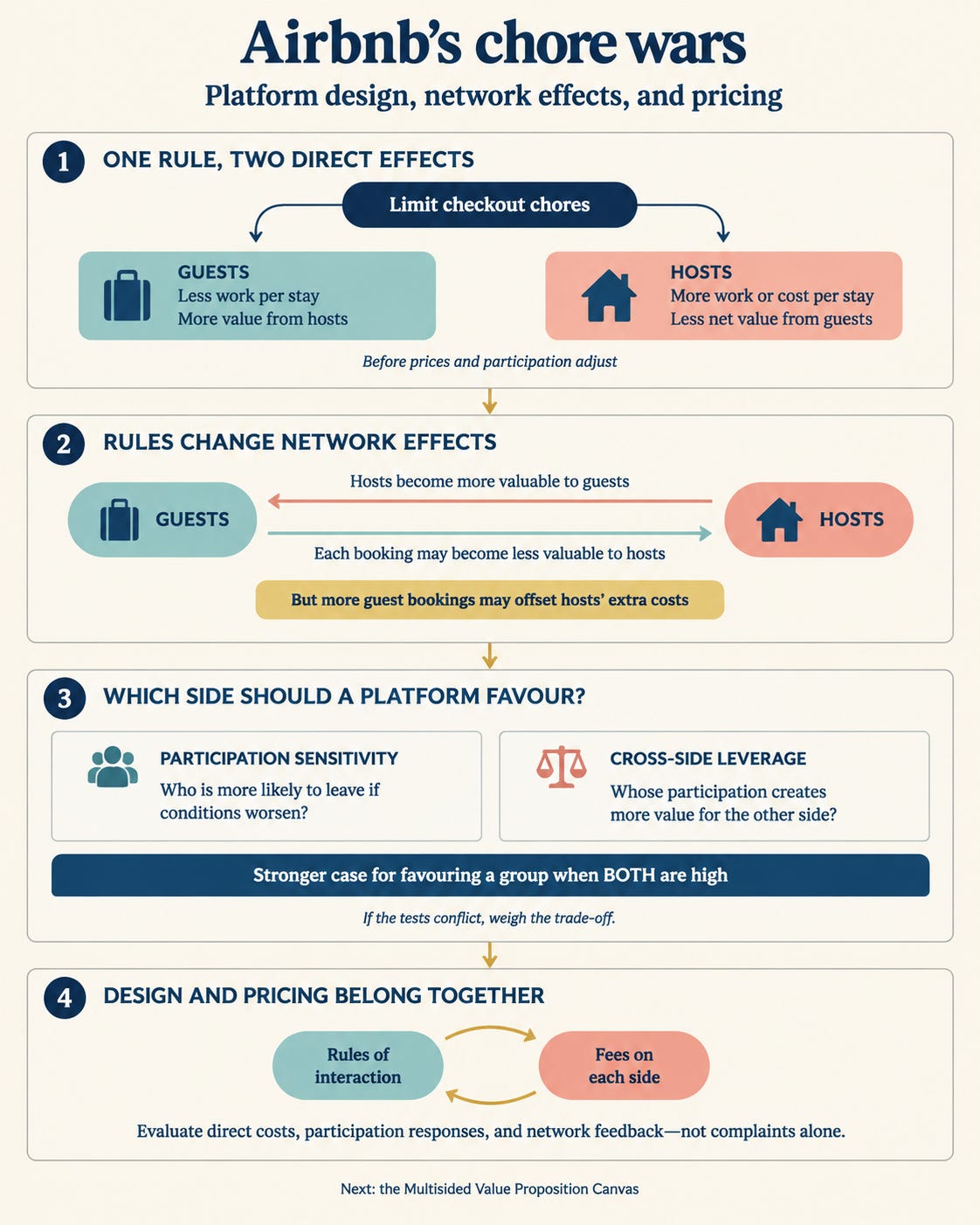
Holding prices and participation constant, Airbnb’s policy can therefore be understood as strengthening the network effect that hosts exert on guests while weakening the network effect that guests exert on hosts. This applies the distinction between design choices that improve interaction benefits on both sides and those that move them in opposite directions.
The qualification matters. These are the immediate effects, not necessarily the final outcome. If better conditions attract more guests or encourage more bookings, hosts may ultimately gain enough additional business to offset the extra work. Equally, if enough hosts withdraw, guests could lose accommodation options. The feedback between the two groups can reinforce—or undermine—the initial policy change.
Why this changes the pricing problem
Platform pricing depends on both users’ willingness to participate and the value they create for the opposite group. Platforms therefore often offer favourable prices to one side because attracting those users helps them earn revenue from the other.
Design decisions change these calculations. If a rule increases the value guests obtain from using Airbnb, it can increase their willingness to pay. If the same rule reduces hosts’ expected returns, keeping hosts on board may require more favourable financial terms. But attracting additional guests can also make hosting more valuable, potentially offsetting that need for compensation. The platform must consider these effects together rather than adjusting each side’s price in isolation.
This does not mean Airbnb’s new policy must lead to a particular fee change. It means the platform’s preferred fee structure depends on its rules—and changes when those rules alter the benefits of participation. Moreover, the price of accommodation, set by hosts, is distinct from the fees the platform charges: any attempt by hosts to recover additional cleaning costs through higher accommodation prices could reduce the benefit guests receive.
A checkout obligation is thus part of the economic package offered to each side, even though it does not appear as a monetary charge.
3. Whom should the platform favour?
When the interests of two groups conflict, “keep everyone happy” is not a decision rule. Nor is “listen to whoever complains the loudest.”
A more useful starting point comes from platform pricing: favouring one group can be worthwhile because its participation benefits the whole platform. Two considerations are central—how strongly users respond to their terms of participation, and how strongly their participation attracts the other side.
First, who is most likely to walk away?
In pricing, the relevant concept is the elasticity of participation: how strongly participation changes when the price changes. All else equal, a price reduction attracts more users when they are more price-responsive. Conversely, raising the price for that group risks losing more participants.
The same reasoning provides a guide to non-price decisions, with an important distinction: sensitivity to money need not equal sensitivity to chores, cancellation restrictions, or other obligations. What matters for Airbnb’s decision is how strongly guests’ and hosts’ participation responds to this particular change in conditions.
Consider the competing possibilities:
- If checkout chores deter many travellers from booking, while most hosts remain despite the additional burden, guest-friendly rules become more attractive.
- If guests barely change their booking behaviour, while many hosts remove their listings or reduce availability, the same policy becomes harder to justify.
These are scenarios, not findings about Airbnb. The reported complaints and threatened departures show a conflict exists; they do not tell us how participation will respond in either group.
The strategic question is therefore not simply who dislikes the policy. It is whose behaviour changes—and by how much.
Second, whose participation has the strongest pull?
Participation also matters through its effect on the opposite side. A platform has a stronger incentive to attract a group whose presence generates particularly large benefits for the other group. This is the logic of leverage-based pricing.
Think of a lever. Improving one group’s terms is the initial effort. More users participate on that side. Cross-side network effects then transmit the benefit to the other side, making participation there more attractive too. The stronger that transmission, the more powerful the lever.
Applied to Airbnb, the argument for favouring guests would be that retaining or attracting them generates enough additional booking opportunities to make hosting attractive despite the extra cleaning burden. Hosts may dislike the new obligation yet still prefer a platform that delivers more business.
But the reverse argument also matters. Hosts supply the accommodation that attracts guests in the first place. If a rule drives away hosts whose properties are particularly valuable to travellers, the resulting loss of choice could outweigh the improvement in checkout conditions. Both directions of the network effect must enter the calculation.
Combine the two tests
The clearest case for favouring a group arises when it is both highly responsive to its participation conditions and a powerful source of value for the opposite side. Improving its terms then produces a substantial direct response and a strong indirect response. This extends the two-part logic of leverage-based pricing to platform design.
When the two tests point in different directions, the choice is harder. One group may be more likely to leave, while the other has greater attraction power. The platform must then weigh the size of the direct gains and losses, the resulting feedback between groups, and the scope for adjusting prices.
This also explains why favouring guests need not mean disregarding hosts. A guest-friendly rule could, in principle, be accompanied by lower host fees or other measures that reduce the burden on hosts. Design and pricing are complementary instruments: a platform can change how transactions work while adjusting how their benefits and costs are shared.
The economic interpretation of Airbnb’s decision is therefore a hypothesis about its strategic calculation: the company may expect the gains from a better guest experience, including the business those guests bring to hosts, to outweigh the costs of less favourable hosting conditions. The news report does not establish whether that calculation is correct.
Nor should we confuse profitability with fairness. Explaining why a platform might favour one group does not establish that the resulting allocation of work, risk, and revenue is fair.
Here is a quick summary of the various arguments developed so far.
4. Next: designing these trade-offs from the outset
Airbnb’s checkout dispute concerns an established platform changing its rules. For a nascent platform, the challenge comes earlier: which promises should it make to each group before expectations harden?
In the next post, I will use the Multisided Value Proposition Canvas developed with Nicolas Neysen in Platform Strategies to explore that question. The canvas is presented in the book’s chapter on co-creating value with platform users, including an application to Airbnb.
The aim will be practical: to help founders identify where the needs of their user groups reinforce one another, where they conflict, and which design choices can reconcile them—or require an explicit trade-off.
Before deciding who should strip the beds, a platform needs to understand whose participation it is trying to secure, what those users contribute to others, and how its rules will sustain that exchange.