Amazon Mechanical Turk has closed its doors. The marketplace that once promised to put “human intelligence” at the end of an API call—request in, answer out—ceased operations on 30 September 2026.
The obvious question is why Amazon would shut down a service built on something that seems more valuable than ever: access to humans for tasks that machines still struggle to perform well.
A platform-strategy answer is this: platforms do not survive merely because they connect people. They survive when they solve a coordination problem better than the alternatives—and when users continue to trust the quality of the interactions they make possible. When either condition weakens, even an Amazon-backed platform can disappear.
The original trick
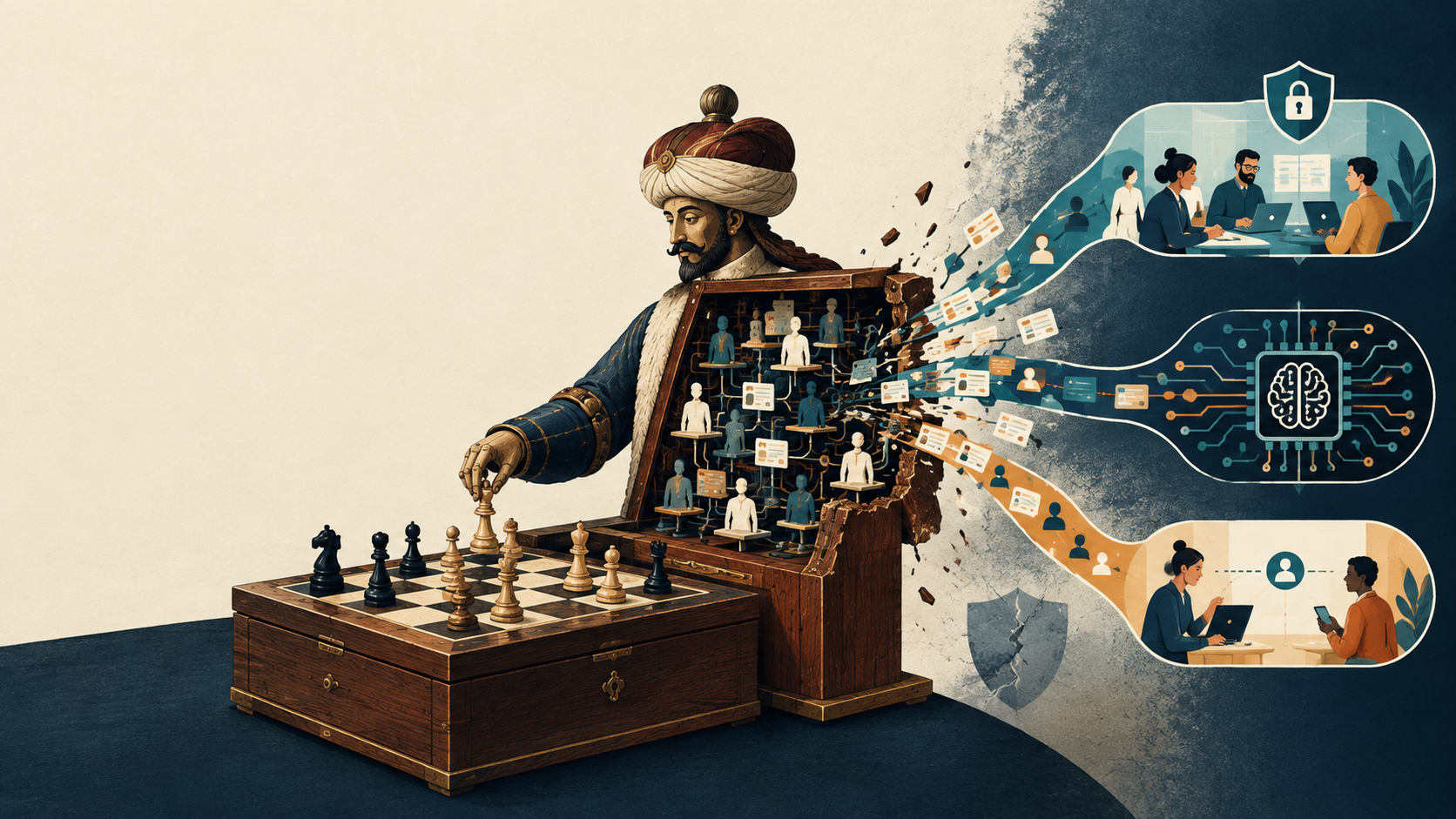
Mechanical Turk’s name referred to the eighteenth-century chess-playing automaton that appeared to be a machine but hid a human player inside. Amazon’s version applied the same idea to digital work: software could call on humans to perform tasks and return the results almost as if they were a computational service.
Its proposition was elegant. Requesters—researchers, firms, and developers—could access a large pool of workers for surveys, transcription, image labelling, content moderation, and other tasks requiring human judgment. Workers, in turn, could find small paid jobs to complete remotely and flexibly.
This is exactly the kind of opportunity that platforms are meant to exploit. As argued in Platform Strategies, a platform creates value by bringing together agents with complementary needs and reducing the transaction costs that prevent them from interacting efficiently: search, matching, payment, monitoring, and trust-building.
Without MTurk, a researcher seeking survey participants or a firm needing thousands of labelled images would have had to recruit, screen, pay, and supervise contributors directly. The platform made these exchanges scalable.
When the advantage fades
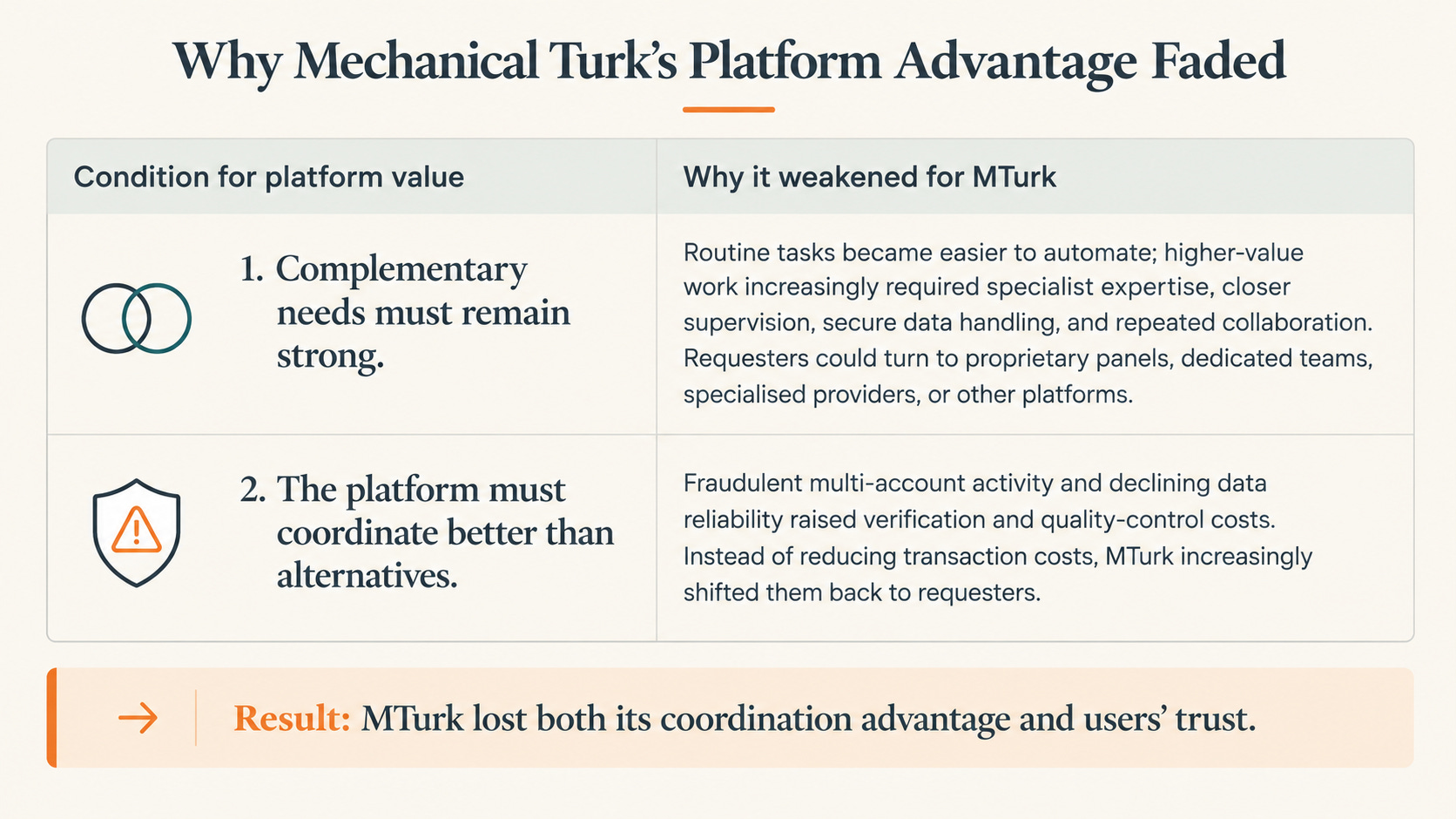
But a platform’s value is never permanent. It depends on two conditions: users must benefit from interacting, and they must not be able to organise that interaction more effectively by other means.
MTurk’s closure suggests both conditions came under pressure. Some of the routine tasks that once made crowd work attractive can now be automated. Other tasks still require humans, but in more specialised, better supervised, or more secure settings. This makes specialised providers, proprietary panels, dedicated teams, or alternative platforms more attractive than a broad, general-purpose marketplace.[3][4]
That is one side of the story: disintermediation. Human labour did not disappear, but requesters increasingly had other ways to access it.
The second side is trust. For researchers, MTurk’s value depended not just on access to respondents, but on the reliability of the data collected through the platform. Recent research points to a serious deterioration on that front. A 2025 study identified evidence of large-scale fraudulent multi-account behaviour on MTurk, with suspicious “puppet” accounts representing roughly one-third of accounts in one study and more than half in another. The authors argue that such activity threatens the integrity of data collected on the platform and reflects broader weaknesses in its quality controls.
This matters because the lack of trust is itself a source of transaction costs. If requesters can no longer trust workers’ identity, independence, or attentiveness, the platform no longer reduces coordination costs; it increases them. Researchers must then spend more time screening responses, designing countermeasures, and worrying about result contamination. The platform starts to lose its core economic function.
The reverse network effect
Platforms benefit from feedback loops. More workers make MTurk more attractive to requesters; more requesters create more earning opportunities for workers. This is the positive network effect at the heart of the model. But the loop can reverse. If requesters perceive lower quality or find better alternatives, fewer tasks are posted. With fewer tasks available, workers become less active, which in turn makes the platform less attractive to requesters. A virtuous circle turns vicious.
This is where MTurk begins to resemble two other platform stories discussed on this blog.
In the case of E3, the key issue was disintermediation. Major game publishers discovered that they could reach professionals, media, and players through their own digital showcases and direct communication channels. The interaction remained valuable, but E3 was no longer the best way to organise it.
At the Angoulême comics festival, the key issue was governance and trust. Authors, publishers, and funders progressively lost confidence in the organiser, and once these defections began, the festival’s attractiveness deteriorated for everyone else.
MTurk now appears to sit at the intersection of these two stories. Like E3, it seems to have lost ground because alternative forms of coordination became more effective. But like the Angoulême festival, it also appears to have suffered from an erosion of trust that undermined the quality of interactions on the platform.
The platform lesson
Mechanical Turk’s last trick is therefore to remind us of a basic platform principle.
Platforms emerge because they solve coordination failures and lower transaction costs between groups with complementary needs. They grow when network effects reinforce participation. But they can decline when users find more efficient ways to coordinate—or when deteriorating trust and quality make the platform less valuable as an intermediary.
Amazon Mechanical Turk did not disappear because human intelligence became useless. It disappeared because organising human intelligence through that particular platform may no longer have been the most efficient—or the most trustworthy—way to do it.