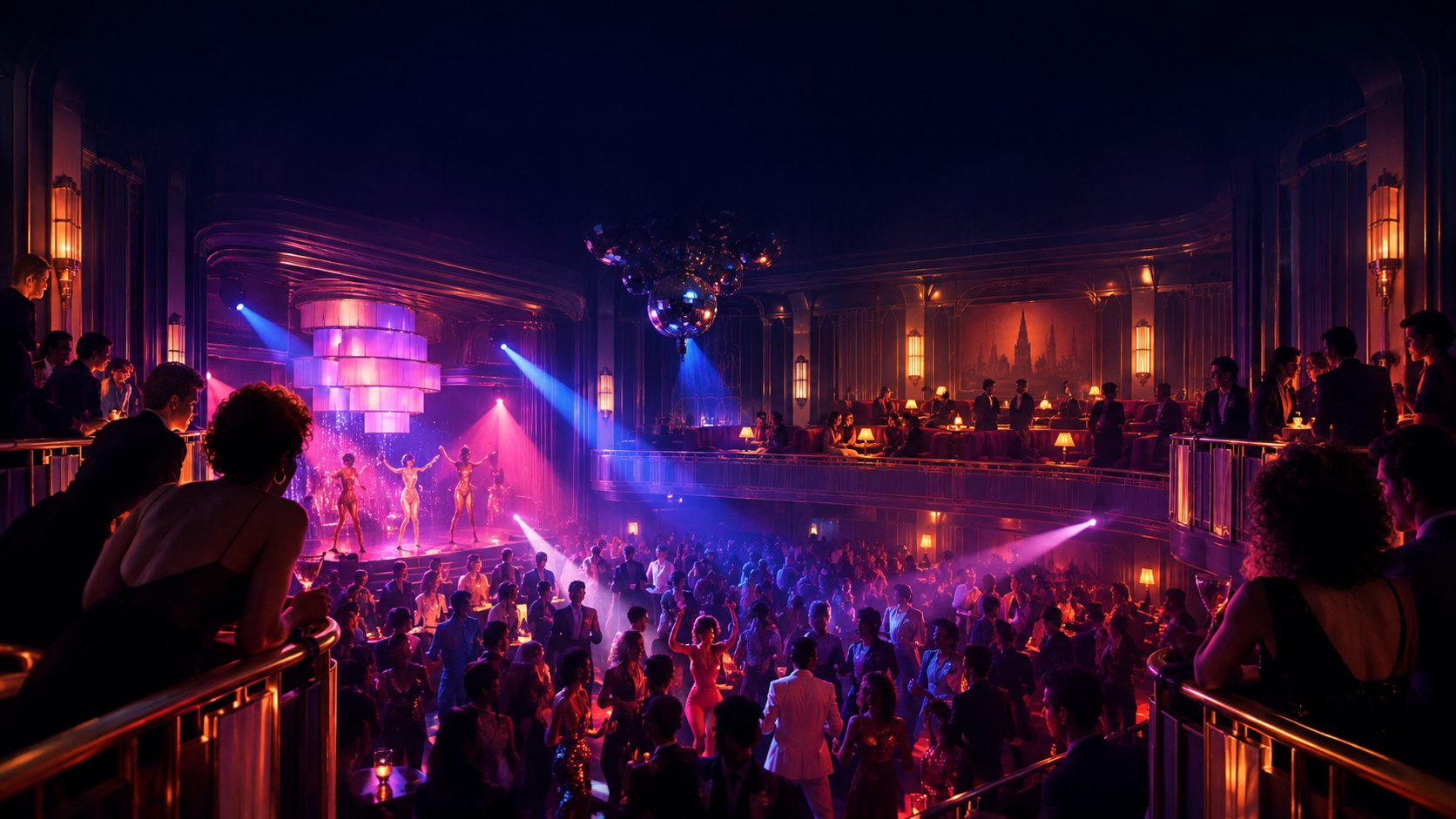
Long before Facebook, Tinder, or Airbnb, Brussels had Mirano. In the 1980s, this former cinema was not just a nightclub but a carefully designed social infrastructure: a place where people came to dance, watch, talk, flirt, discover music, and make connections. In that sense, Mirano belongs to the same family of brick-and-mortar platforms as Batibouw, the Angoulême festival, or E3: physical venues that create value by orchestrating interactions among distinct but interdependent groups.
This is fully consistent with the definition of a platform proposed in Platform Strategies. A platform brings together agents with complementary needs, reduces interaction costs, and increases the value of participation by leveraging network effects. Crucially, nothing in that definition requires a digital interface: platforms can operate through physical spaces too, much like traditional marketplaces did long before the internet.
The documentary Mirano 80: L’Espace d’un rêve, by Luc Jabon and Thomas Purcaro Decaro, offers a rich set of testimonies from those who built and animated the venue. Read through a platform lens, these recollections show that Mirano didn’t just host parties; it actively managed an ecosystem.
Designing complementary roles
Marco Rolland: “It wasn’t a place where you went just to dance. The music was the excuse. But there were different spaces. So, when you entered the Mirano, there were just as many spaces that allowed for conversation. You’d walk in, and there was what we called the ‘parlour,’ the ‘small lounge.’ And the second part, very interesting and innovative as well, was the balconies and the upper floor. I always called those [who went there] the ‘voyeurs.’ So, the slightly more introverted people, who observe the dance floor and watch people dance, and so on, and who observe that. There was a place for them too. And the delicate balance between these three audiences—that is, the intellectuals who wanted to converse, those who wanted to watch (that is, the voyeurs), and the actors—that’s what made the Mirano so rich.”
Mirano’s brilliance lay in recognising that a nightclub does not serve one undifferentiated crowd. It serves different participation modes. Some people wanted to perform, some to observe, and some to converse. The venue’s architecture gave each group a place while keeping their experiences connected (see this video).
This is precisely the kind of situation that platform economics helps illuminate. The dancers and the observers generated cross-group value for one another: the more compelling the dance floor, the more interesting it became to watch; and the more attentive the audience, the more rewarding it was to perform. Meanwhile, the lounge catered to a group whose value depended more on the quality and variety of the people present in their own space. In the language of Platform Strategies, Mirano was activating both cross-side and same-side network effects.
Interestingly, this is not just an analogy imposed after the fact. The economics literature has long used dating clubs and nightclubs as intuitive examples of two-sided markets, in which the value of participation depends on attracting interdependent groups (see, e.g., Evans, 2003 or Wright, 2004).
Curating the right mix
In such settings, attracting more people is not enough: the operator must manage the composition of attendance, cross-group attraction, and the congestion that arises when space becomes scarce.
Marco Rolland: “I spent my time between the entrance and the auditorium. As it was a multi-purpose space requiring an extremely delicate balance between spectators and participants, it was essential not to have only spectators. Every half hour or every hour, I would go inside, take the pulse, observe for a bit, and then come back. I would say: ‘Well, here, we’re lacking a few jokers, we’re lacking actors, we’re lacking creative people.’”
This is perhaps the clearest evidence that Mirano was managed as a platform. Rolland wasn’t merely counting bodies; he was monitoring the crowd’s composition. A room full of spectators is dull because there is nothing to see. A room full of performers can be just as ineffective if no one is watching. What matters is not scale alone, but balance.
Platform operators constantly face this problem. Their task is to manage the mix of participants so that each group finds enough value in the presence of the others. Digital platforms often do this through pricing, subsidies, and algorithmic ranking. Mirano did it through something more tactile: door policy, timing, circulation, capacity, and human judgment. The “algorithm” was embodied in the staff’s ability to read the room and adjust who entered it.
This point also connects Mirano to a broader cultural literature on nightlife. Recent research on nightclub promoters emphasises how curation, venue design, visibility, and selection work together to attract desired audiences and shape the collective experience (see, e.g., Carah et al., 2021, or Koren and Hracs, 2024). In that sense, Mirano’s selective governance was not incidental; it was central to the platform’s value proposition.
Opening the platform to complementors
Jean-Louis Sbille: “The Mirano was beautiful; there was an audience. So, it was bound to interest promoters and record labels who thought: ‘Let’s organise a showcase at the Mirano. Hey, I’m looking for a date for a band touring Europe, in Belgium; it might be a good idea to present these bands at the Mirano.’”
Marco Rolland: “We invented events for Perrier that were completely innovative. We had a 1950s-style car, fully enclosed, that would pick up the stars when they arrived in Brussels, and so on. So it was a form of subtle advertising, product placement, in a way. And so Perrier found itself associated with all sorts of events. Later, we also launched the first 36 m² billboard for Swatch. We had leather goods, including Delvaux and other brands.”
Once Mirano had assembled a distinctive audience, it became valuable to third parties. Promoters, record labels, artists, and brands all wanted access to the community that Mirano had curated. This is a classic platform move: after solving the initial coordination problem and reaching a form of critical mass, the platform can expand its ecosystem by bringing in complementors.
But this is never a purely commercial decision. In platform strategy, complementors strengthen the platform only if they fit its core promise. A badly chosen advertiser or event partner may alienate users rather than enrich their experience. Mirano appears to have understood this instinctively. Perrier, Swatch, Delvaux, and music showcases did not merely provide revenue; they reinforced an image of style, novelty, and cultural credibility.
Here again, the parallel with other brick-and-mortar platforms is instructive. Just as Batibouw can create value by aligning exhibitors, financiers, and visitors around a coherent narrative of construction and renovation, Mirano created value by aligning artistic, social, and commercial actors around a recognisable identity.
A matching intermediary in physical form
Paul Sterk: “I think that Mirano, in its operation, was a kind of Facebook before its time. That is to say, if you came three weekends in a row, you could find what you wanted to find, both professionally and romantically.”
Sterk’s comparison is provocative, but it captures something essential. Mirano was not “like Facebook” because it had profiles or data. It was “like Facebook” because it reduced the cost of finding people, facilitated repeated interactions, and made social matching easier within a recognisable community.
That is why the best academic description of Mirano may be this: a brick-and-mortar matching platform. It brought together people looking for encounters, visibility, recognition, collaboration, romance, or simply the pleasure of being part of a scene. By creating a recurring setting for these interactions, it transformed nightlife into a platform service. The platform was not the building alone; it was the organised set of expectations, rituals, and participant roles that the building made possible.
The party as platform
Mirano’s story reinforces a point that runs through several posts on this Substack: platforms are not defined by code but by coordination. Batibouw, Angoulême, E3, and Mirano all show that physical venues can function as platforms when they bring together interdependent groups, lower interaction costs, and actively manage the conditions under which value is co-created.
What makes Mirano especially compelling is that it never formalised its “platform strategy” in those terms. Yet the logic is unmistakable. It designed complementary user roles, curated their balance, selectively opened itself to complementors, and turned repeated attendance into a mechanism for trust, recognition, and matching. Long before platform strategy became a field of study, Mirano was already putting it into practice.
A personal postscript
I was a young teenager in the 1980s: a little too young—and too provincial—to join the Mirano parties myself. Yet watching Mirano 80: The Space of a Dream brought back a musical world that has remained very close to my heart: new wave and dark wave alongside funk, dance, and soul. The documentary is therefore more than a compelling account of an extraordinary Brussels venue. It is also a wonderful invitation to listen again—to the sounds that made an era, but that have lost none of their emotional force.
To extend that invitation, I am sharing this remarkable Mirano Spotify playlist. Its striking diversity is perhaps the best musical counterpart to the Mirano story: new wave and dark wave rub shoulders with funk, dance, soul, disco, electro, and much else besides. Rather than offering a single, neatly bounded “sound of the 1980s,” it conveys the exhilarating eclecticism that made the venue—and the decade—so distinctive. Mirano was a place where different people could meet; this playlist reminds us that it was also a place where very different musical worlds could meet, collide, and come alive together.