In a recent essay titled “The Real Reason that Substack is Collapsing,” journalist Scott Carney offers a rich case study for economists interested in platform dynamics. Several of his observations map directly onto three distinct — and compounding — mechanisms of value destruction that I analysed in earlier posts and which I re-examine here: enshittification proper, mission drift, and negative external effects.
The original value proposition and its erosion
Carney opens by recalling Substack’s founding premise: “writers could come here to build an audience that would actually pay directly for their writing,” escaping the attention-and-advertising logic of mainstream media. That “Why” — readers as customers rather than eyeballs sold to advertisers — is precisely the kind of mission a platform is meant to embed and protect as it scales.
What follows in the piece, however, is a textbook illustration of mission drift. As I’ve argued elsewhere, platforms drift away from their founding purpose as new investors, governance shifts, and growth metrics pull them toward different priorities. Carney describes this shift explicitly: Substack “pivoted to adding a twitter-like function called ‘Notes’... incorporated video and live-streaming and encouraged posters to clip shorts into their feeds with an AI-generated clipping program“. This is more than an expansion of the platform’s functionality; it reflects a reorientation of the platform’s objectives: away from facilitating direct writer–reader relationships and towards maximising engagement and scale. The tell is in Carney’s own diagnosis: these new features increased “the overall number of eyeballs“ without helping “the flood of new creators who came here to actually earn more money“ — in fact, he notes, “they started earning a lot less“. A platform whose growth metric decouples from its founding value proposition is drifting, almost by definition.
A race to the bottom, not (only) classic enshittification
Cory Doctorow’s “enshittification” is explicitly invoked in Carney’s essay, and rightly so as a shorthand. But the mechanism he describes is subtly different from the canonical story, in which a platform first favours users, then business customers, then shareholders, degrading each group’s experience in turn to extract rents. Here, Carney identifies something closer to intensified horizontal rivalry: “Without a bigger pie, individual Substack creators are instead forced into direct competition with one another. The only way to grow is to pillage the paid subscribers from other creators“. Reader attention and subscription budgets are treated as essentially fixed — “on a good day my brain can only keep up with about 5 newsletters“ — so adding thousands of new writers to the platform does not expand aggregate demand; it redistributes a stagnant one across more claimants. Individual earnings fall even as platform-wide engagement and valuation climb, because those two metrics are no longer tightly coupled to creator welfare. This is less “the platform squeezes you” and more “the platform’s growth strategy makes you squeeze each other” — a distinction worth preserving analytically, since the policy remedies differ (bundling and revenue-sharing mechanisms versus curbing platform-side extraction).
This pattern can also be understood as a growing negative same-side network effect among writers. At an early stage, more writers can make a platform more attractive to readers by increasing variety and improving the chance of finding relevant content. But the effect can turn negative when the supply of writers expands faster than the number of readers willing to pay. Each additional paid publication then competes for scarce attention and a limited subscription budget, reducing the expected revenue available to other writers. The relevant imbalance is therefore not simply between writers and readers, but between paid writers and paying readers. Carney’s argument is precisely that this ratio appears to be deteriorating: the platform attracts more creators and more users consuming free content, while the pool of readers prepared to finance newsletters does not grow commensurately
In that sense, platform growth ceases to be uniformly beneficial on the writer side. A larger creator population may raise aggregate content supply and engagement, yet lower the average probability that any individual writer can build a viable paid audience. What initially looks like a positive cross-side network effect — more writers attracting more readers — thus becomes increasingly offset by a negative same-side effect: more writers competing over too few paying readers.
Externalities beyond the creator-platform relationship
Carney’s essay also gestures, more implicitly, toward a third mechanism I have discussed: negative external effects, where costs are shifted onto parties not fully internal to the platform’s core transaction. A reader comment appended to the piece is telling in this respect: an older, low-income reader describes relying on Substack for “intelligent analysis“ she cannot otherwise afford, warning that paywalls risk pushing such readers toward “unreliable but accessible sources like Fox“. If a subscription platform’s economics push it toward more paywalling and more low-quality free content simultaneously, the externality falls not on paying subscribers or even on creators, but on the broader public sphere and its access to reliable information — a cost that does not show up cleanly in Substack’s own growth metrics, which is exactly why, as I’ve argued, self-regulation tends to under-address such harms.
A view from outside the creator-income model
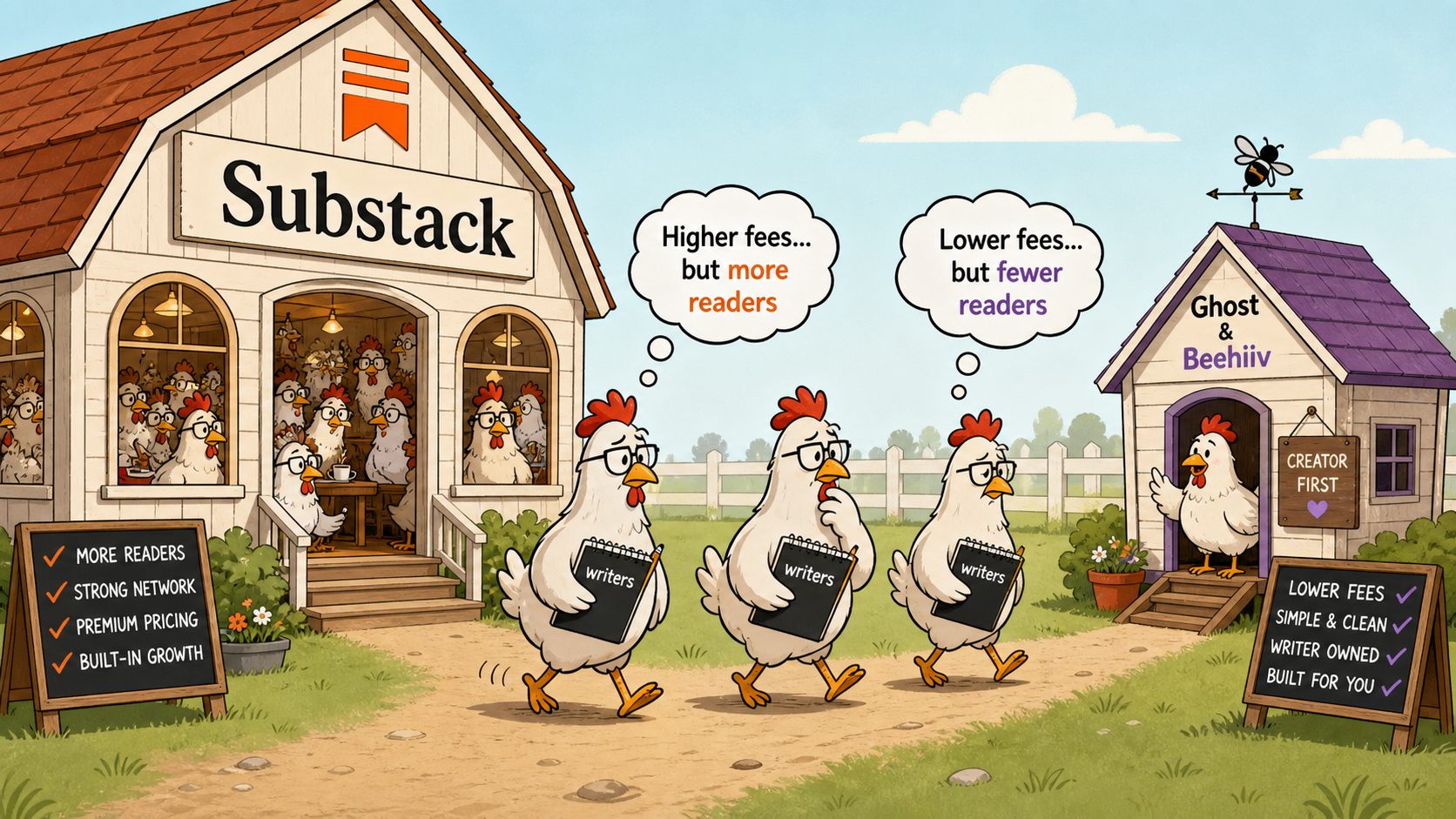
It is worth adding a caveat from a different vantage point. Everything above describes real pressures for writers who need Substack to generate a living wage. But for an academic like me who uses the platform to popularize research rather than to earn income from it, Substack remains, on balance, an excellent tool: it offers free, high-quality publishing infrastructure, a built-in discoverability mechanism absent from platforms like Ghost or Beehiiv, and — crucially — no dependence on the subscriber economics described above. The pathologies of mission drift and race-to-the-bottom competition are real for the platform’s professional writers, but they are largely orthogonal to the use case of a researcher writing to be read rather than to be paid.
Substack may be discovering that a platform cannot be all things to all people—and that trying to be so may ultimately leave too few people well served.