Uber has dramatically widened its travel ambitions. Beyond rides and food delivery, it now lets users book hotel rooms (via a partnership with Expedia and, soon, Vrbo) and promises AI‑powered features like voice‑based trip planning and smarter, integrated travel flows in a single app. In other words, Uber is trying to become the place where you not only request a car or order a meal but also plan, book, and manage an entire door-to-door trip.
These moves echo some of the core themes from our earlier discussions of super apps and Uber’s other diversification efforts. In that blog, we argued that “super‑app” strategies hinge on bundling strongly complementary services around a shared user base and data layer, but that success depends on staying close to the platform’s core, working with complementors rather than against them, and recognising that Western markets differ sharply from the Asian contexts where super‑apps first flourished. Uber’s expansion into hotels and AI‑driven travel looks like a textbook attempt at “envelopment through increased value”: it leverages an existing mobility and delivery platform to add adjacent services, while raising familiar questions about focus, bargaining power with partners, and the limits of super‑app models in the US and Europe.
In what follows, we take a closer look at the main pros and cons of these strategic moves, using the super‑app framework to assess how much value they truly create—and for whom.
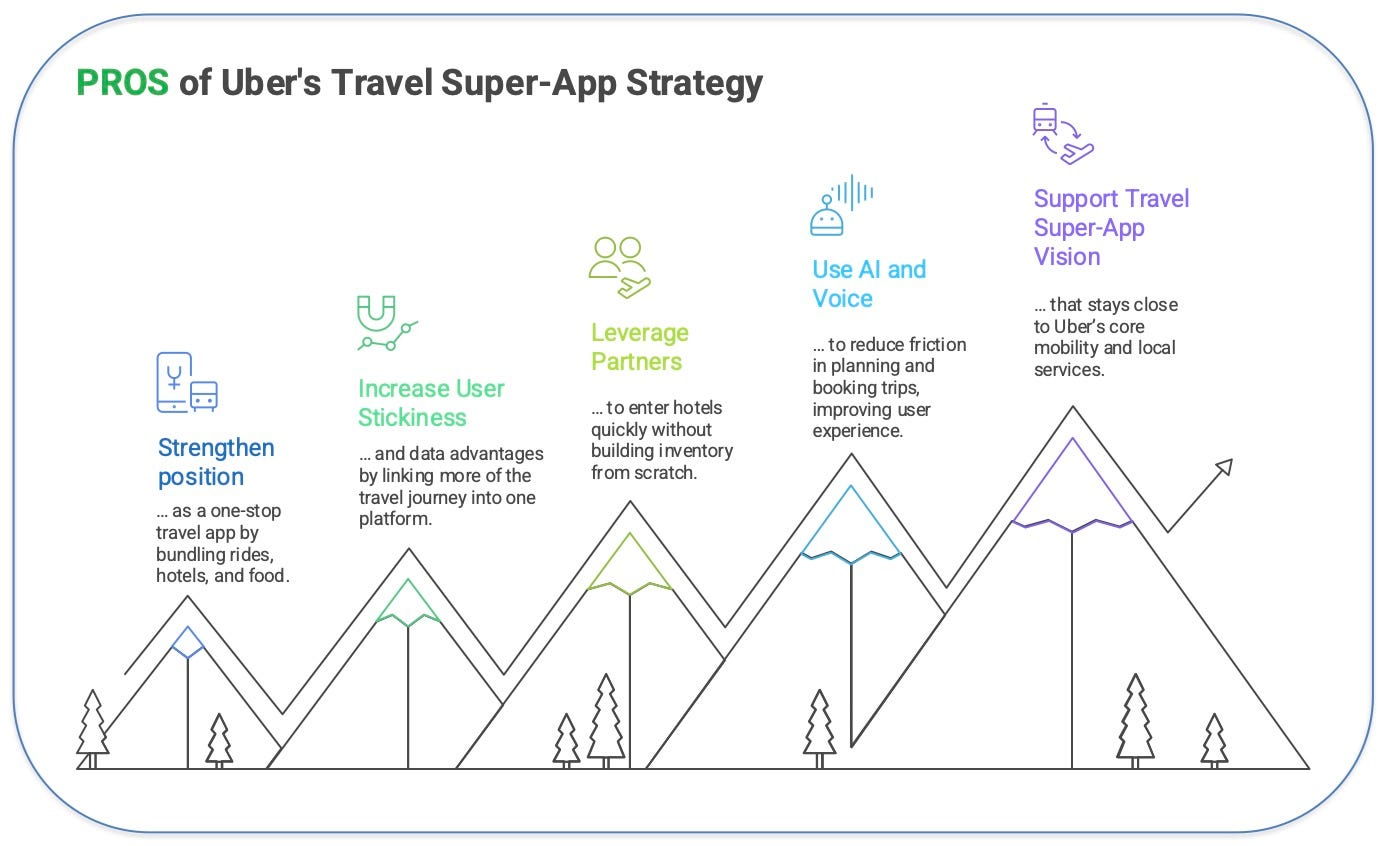
Strategic pros for Uber
1. Strong complementarity and higher user surplus
- In our previous blog, we emphasised that super‑apps look for complementors: services that “go particularly well” with the core to boost attraction and retention (e.g., marketplace + PayPal). Uber’s bundle of ride‑hailing, hotel booking, and Uber Eats “room service” is exactly such a complement set around the travel journey: get to the airport, book the hotel, arrange local rides and meals in one app.
- Expedia and Vrbo provide access to 700,000+ hotels and will add over 1 million vacation rentals, giving immediate breadth of inventory without Uber building a travel marketplace from scratch; this amplifies the one-stop-shop value for users.
2. Deeper network effects and user lock‑in
- As we explained before, by aggregating complementary services, platforms can strengthen network effects and make it harder for single‑service rivals to lure users away. As more travellers use Uber not just for trips but for lodging, Uber can accumulate richer cross‑context data (mobility, spending, preferences) and use that to tailor offers, boosting stickiness.tech.
- Uber One perks (e.g. 20% discounts on a rotating set of 10,000+ hotels and 10% back in Uber credits on bookings) tie travel spend into Uber’s subscription ecosystem, making churn more costly for heavy users. This mirrors the idea that combining services into bundles can create surplus that pure‑play competitors struggle to match.
3. Efficient envelopment via complementors instead of full‑stack entry
- Instead of becoming a direct hotel online travel agent (OTA), Uber is effectively turning a potential competitor (Expedia) into a complementor, which our analysis frames as a recommended defensive move against would‑be super‑apps.
- The partnership works both ways: Expedia gets Uber rides integrated into its app, and Uber gets hotel inventory; this mutual complementarity can deepen the ecosystem and increase switching costs for users and partners.
4. AI‑driven speed and product scope
- Uber’s CTO explains that “agentic AI” tools have halved typical development timelines for complex features such as hotel booking, voice booking, and travel search, turning ideas into live products in months rather than a year.
- Faster build-test cycles allow Uber to experiment with multiple adjacent services (travel mode guides, “Eats for the Way,” room-service-style delivery) and scale the ones that materially increase user value, which is a good fit for our view that envelopment is often incremental and path-dependent.
5. Strategic coherence within a “travel super‑app” vision
- Our previous blog warns that Western firms calling themselves super-apps typically remain near their original sector, and that over-diversification is risky. Uber’s hotel and travel features are still clearly anchored in mobility and local services (rides, food, travel logistics), which keeps the strategy coherent rather than conglomerate-like.
- Previous moves such as integrating additional transport modes (e.g., other mobility services, as discussed in our previous piece on Uber’s diversification) show a consistent pattern of envelopment within the travel domain rather than unrelated diversification.
Strategic cons and risks
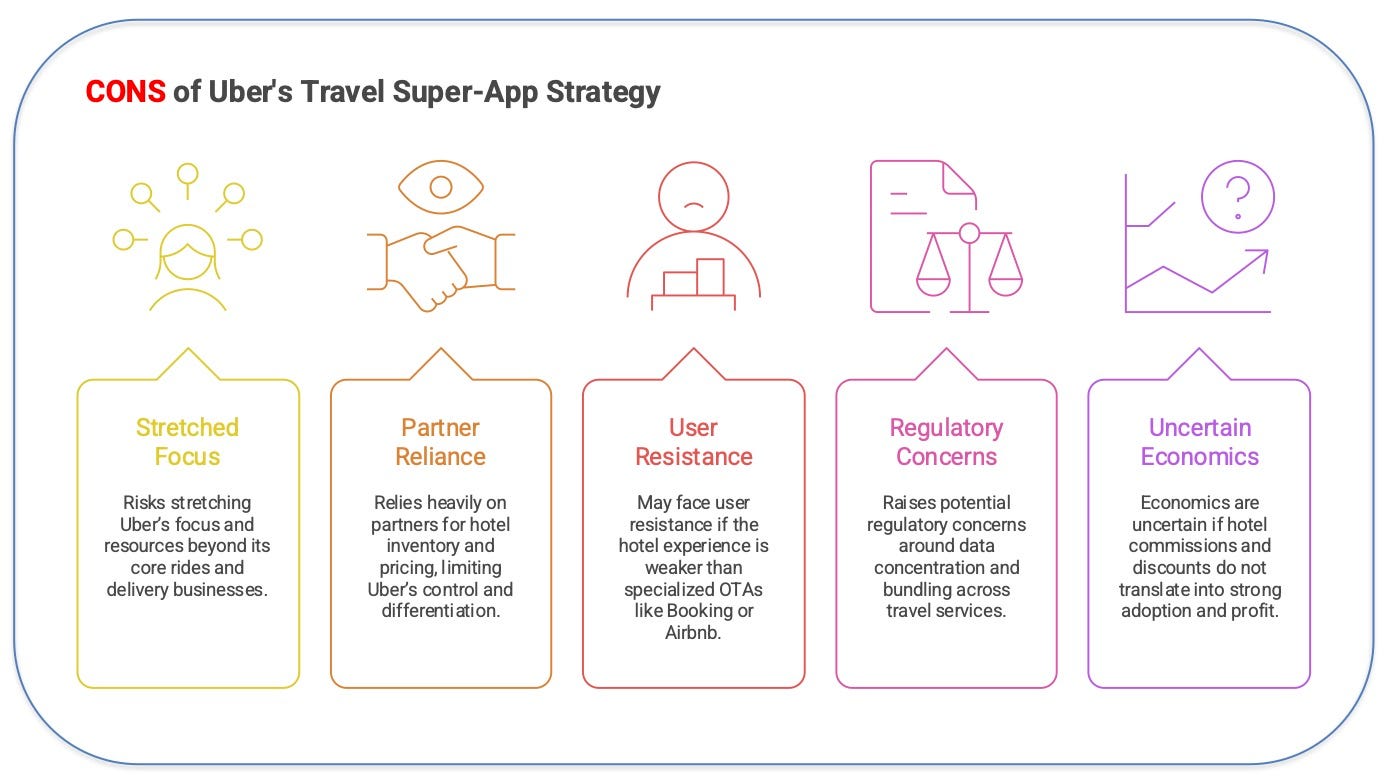
1. Super‑app ambition vs. Western market reality
- We explained earlier that super-apps like WeChat and Meituan emerged in a regulatory and competitive environment very different from that in the West (e.g., restricted access for Western apps, strong homegrown ecosystems) and that copying the “Chinese model” is dangerous. Uber’s “app for everything” messaging raises expectations that may not match user demand or regulatory tolerance in the US and EU.
- Western consumers often prefer specialized apps for complex tasks like hotel search, with rich filters, loyalty programs, and detailed reviews; Uber must avoid becoming a “jack of all trades” with mediocre hotel UX relative to Expedia, Booking, or Airbnb.
2. Execution complexity and focus dilution
- Our previous analysis noted that super‑apps are often built gradually from a core, but warned against arbitrary diversification and complexity. Hotel booking introduces new operational dependencies: inventory management, customer support for hotel issues, post-stay disputes, and integration with loyalty and cancellation policies across hundreds of thousands of properties.
- Uber’s core challenge has historically been profitability in rides and delivery; layering on hotel booking, travel guides, room‑service‑style logistics, and voice AI risks stretching product, engineering, and operations teams, especially if each feature requires tailored support and experimentation.
3. Dependence and bargaining power with complementors
- In our book, we argue that a smart growth strategy is to turn potential competitors into complementors, but this also creates interdependence. Uber’s hotel inventory, pricing and much of the lodging UX are mediated by Expedia and Vrbo, which may limit Uber’s ability to differentiate or capture higher margins over time.
- If Uber successfully intermediates hotel demand, it could eventually be seen by hotels or Expedia as a powerful gatekeeper, triggering conflicts similar to those between app stores and app developers; in the book, we hint that complementor relationships have to be managed carefully to avoid them turning into full‑blown competitors later.
4. Regulatory and competitive concerns around data and bundling
- Super-apps aggregate vast amounts of personal and transactional data, raising competitive concerns. Uber’s combination of location data, travel history, hotel bookings and payment data may attract antitrust attention if it starts to disadvantage rival travel or mobility services through self‑preferencing or exclusionary bundling.
- Travel‑related markets (airlines, hotels, OTAs) are already under scrutiny for algorithmic pricing and opaque ranking; Uber’s AI‑driven hotel recommendations and discounts could be questioned if they systematically favour certain partners or its own economics over consumer welfare.
5. Uncertain user adoption and monetization economics
- Our previous blog reminds us that outside China, diversification moves branded as “super‑app” strategies have “highly uncertain” commercial success. Uber must prove that users actually want to book hotels through the Uber app rather than going directly to Expedia, Booking.com, Airbnb, or Google Travel.
- Margin structure is unclear: commissions will be shared with Expedia; generous discounts and Uber Credit cashback for Uber One members are effectively marketing spend that must be recouped through higher volumes, cross‑sell (rides, Eats) or subscription retention. If adoption is moderate, Uber risks adding complexity and cost without commensurate profit.
Net assessment: Conditions for success
If we apply the Platform Strategies framework, the move has several features of a “good” envelopment strategy: strong complementarity (rides–hotels–food), clear user surplus from one-stop travel, reliance on complementors rather than vertical integration, and incremental expansion within the core travel vertical. These are all positives.
The risks lie mainly in three areas:
- Whether Western users truly want super‑app‑style bundling at scale, especially for complex services like travel.
- Whether the complementor relationship (with Expedia/Vrbo) remains symbiotic rather than becoming a source of strategic dependence or conflict.
- Whether regulatory and competitive scrutiny of data aggregation and bundling intensifies as Uber edges closer to a “travel super‑app.”
In that sense, Uber’s hotel and AI announcements look more like a defensible, platform‑savvy extension of its travel ecosystem than a reckless super-app bet—but their success will depend on disciplined scope (staying close to travel), real user traction, and careful governance of complementors and data.