
In the first post of this series, the focus was on enshittification: the way platforms can gradually reallocate value away from users and towards themselves, until the experience deteriorates for everyone involved. In the second post, the lens widened to mission drift: how platforms can move away from their original purpose as they scale, serve new constituencies, and become steered by different goals. These two dynamics already show that platform decline is not only about what happens inside the platform, but also about how platforms evolve over time.
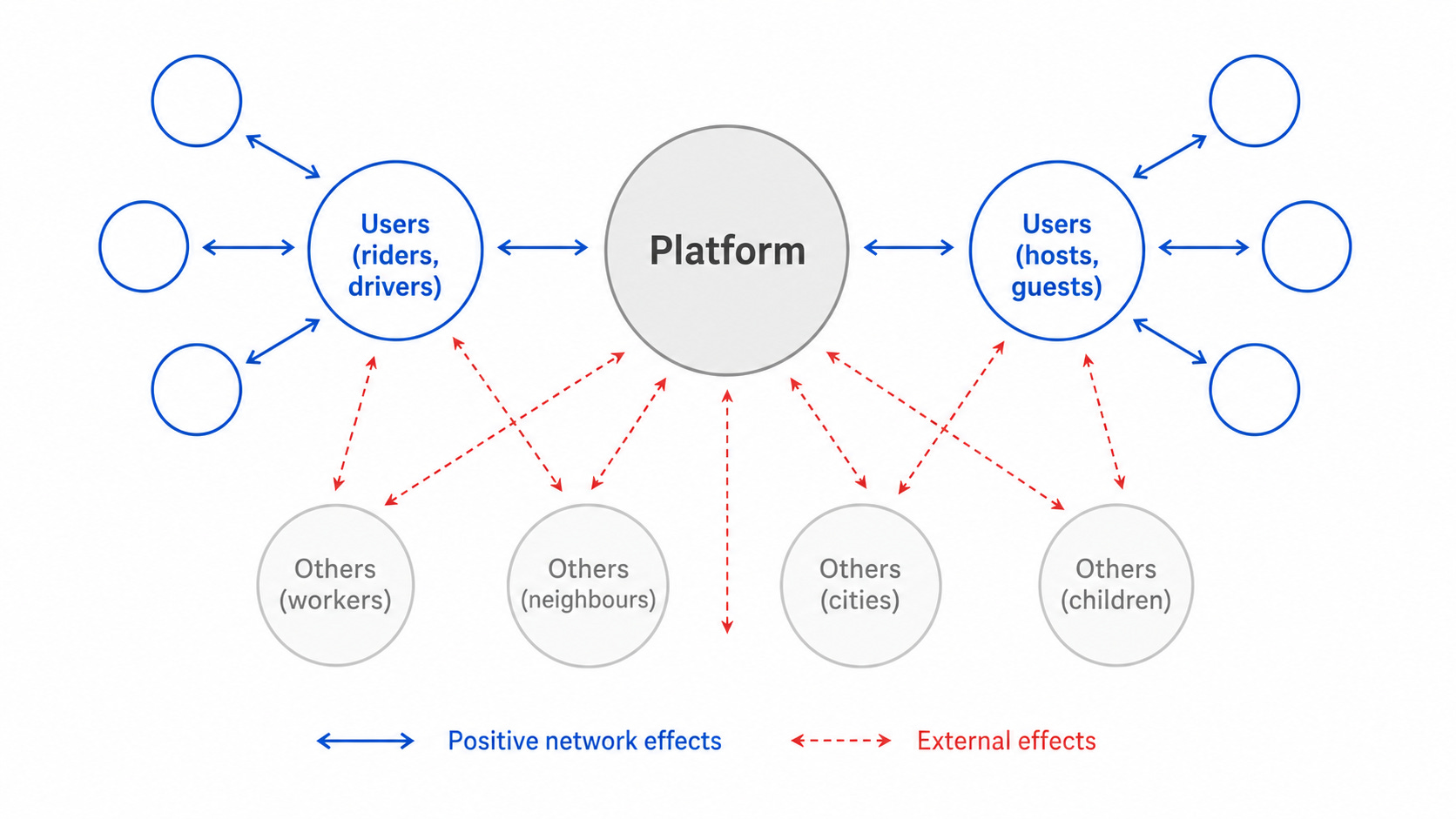
This post adds a third mechanism of value destruction: negative external effects. Here, the problem is not only what happens between the platform and its users, but also what happens to workers, neighbours, cities, and public institutions that are affected by the platform without being fully part of the transaction. A platform may look highly successful from the inside while quietly shifting costs onto others.
The main types
Negative external effects take different forms, but several recurring patterns appear across platform markets.
Social networks and children
Since 2003, thousands of plaintiffs have filed cases alleging that major platforms intentionally designed addictive products for children and teenagers, using features such as autoplay, infinite scroll, and persistent feeds to exploit the brain’s reward system and maximise engagement. In a recent California case, the plaintiff alleges that intensive use of YouTube, Meta, Snap, and TikTok during childhood contributed to depression, anxiety, body-image problems, sleep disruption, weaker in-person social life, and family strain.
What is striking, from an economic perspective, is that the alleged harm does not come primarily from any single piece of content. The argument increasingly focuses on design: recommendation systems, notifications, auto-play, and endless scroll are accused of creating an addictive environment that keeps minors engaged longer than is healthy. In other words, the externality is embedded in the platform’s architecture. This matters because it shifts the debate. For a long time, platforms could claim that they merely hosted user content and should not be held responsible for what users posted. The new litigation strategy instead treats social media as a product that may be defectively designed for vulnerable users, especially children. Whether the courts ultimately accept that argument remains to be seen, but the legal shift is already significant.
In a future post, I intend to take a closer look at the addiction to social networks by addressing the following questions: to what extent do platforms deliberately exploit behavioural vulnerabilities, and what should policy do about it?
Housing pressure
Short-term rental platforms are often accused of reducing the supply of long-term housing and contributing to rent increases in high-demand neighbourhoods. What begins as “home sharing” can, at scale, become a mechanism that reallocates housing stock from residents to visitors. This is why many European cities have become far more assertive in regulating such platforms.
Back in 2020, Huan Ha and I published a post titled “Sharing economy and tourism: who wins and who loses?” in which we tried to map the gains and losses associated with these platforms for tourists, residents, traditional accommodation providers, and cities. Since then, both the empirical literature and the regulatory environment have evolved rapidly. I will review this in a future post.
Congestion and nuisance
Some platforms intensify the use of already scarce urban resources and create burdens for people who are not part of the transaction. Short-term rental platforms can generate noise, traffic, parking pressure, and a loss of neighbourhood cohesion for local residents. Traffic-routing apps offer another, subtler example: by redirecting drivers away from congested arteries and into smaller streets, they may reduce travel time for some users while increasing congestion, noise, and safety risks for residents of the rerouted neighbourhoods. That is precisely the issue I discussed in an earlier post on the price of being rerouted.
Labour precarity
Ride-hailing and delivery platforms create value for riders, diners, and investors, but often do so by shifting risks onto workers. Drivers and couriers may bear income volatility, insurance gaps, algorithmic control, and weak bargaining power while remaining formally classified as independent contractors. In such cases, part of the platform’s efficiency comes from externalising employment costs that more traditional firms would have to absorb.
How regulators respond
Regulators increasingly try to force platforms to internalise at least part of these external costs. The logic is straightforward: if a platform’s business model causes harm to third parties, public authorities have reason to constrain, tax, monitor, or redesign the activity.
In short-term rentals, the response has included registration schemes, zoning restrictions, caps on rental nights, data-sharing obligations, and authorisation requirements in areas facing housing pressure. At EU level, the Digital Services Act and related initiatives on short-term rentals aim to improve traceability, compliance by design, and authorities’ ability to remove illegal listings or obtain information about hosts.
In labour platforms, regulation has focused more on worker classification, algorithmic management, and employer responsibilities. The underlying question is whether platforms should continue to benefit from the legal fiction that they merely “intermediate” between independent parties when, in practice, they shape prices, conditions, and access to work.
For social media, the regulatory conversation increasingly centres on child protection. Proposed or debated tools include warning labels, limits on push notifications and infinite scroll for minors, tighter age verification, stronger parental controls, and obligations to assess and mitigate mental-health risks.
How platforms respond
Platforms themselves also act against negative external effects, though often selectively and under pressure. Short-term rental platforms share more data with cities, remove non-compliant listings, and develop tools to detect problematic behaviour. Ride-hailing platforms invest in safety features, insurance, and driver support, even if critics argue that these efforts remain partial. Social media platforms have introduced screen-time tools, parental controls, and some changes in content moderation and youth settings.
Yet self-regulation has clear limits. Platforms may have weak incentives to address harms that do not immediately appear in user growth, retention, or revenue. And some external effects are not bugs but by-products of the underlying business model: congestion, housing pressure, labour precarity, and addictive engagement arise precisely because the platform is optimised for scale and intensity. In such cases, platforms may mitigate the symptoms without addressing the cause.
Conclusion
Taken together, the three posts in this series suggest that platforms can destroy value in at least three distinct ways. They can enshittify by extracting too much value from their users; they can undergo mission drift by moving away from their original purpose; and they can generate negative external effects by shifting costs onto people outside the platform’s immediate field of vision.
This broader perspective changes the question we should ask about platforms. The issue is not only whether a platform creates value for its direct users, but also for whom, at whose expense, and under what institutional constraints. A platform can look healthy from the inside while eroding housing access, labour standards, neighbourhood life, or even children’s mental health on the outside.
This is precisely why Nicolas Neysen and I, in Platform Strategies, insist that platform entrepreneurs should not stop at mapping the positive links between user groups. In the Linkage Map, and especially in its lower part, we explicitly invite them to think about the potential external effects generated by the platform. The point is simple but important: network effects are not always benign, and the same interactions that create value for some users may impose hidden costs on others.
Seen this way, external harms are not an afterthought to be addressed once the platform has scaled. They should be part of the platform’s strategic design from the start. A responsible platform entrepreneur should therefore ask not only, “How can I strengthen the links that make my platform grow?”, but also, “Who might bear the cost of these links, even if they are not part of the transaction?” That is why the real challenge is not simply to make platforms more efficient, but to make them more accountable for the full range of effects they produce.